Thursday, 23 September 2010

2010 Acura RL Review


2010 Acura RL Review & Test Drive – “Luxury With A High Performance Attitude”
Even though the Acura RL was first introduced in 2005 it still features bold contemporary looks, a powerful V6 engine and Acura’s acclaimed Super Handling All-Wheel Drive (SH-AWD) system. Continuously updated, the 2010 RL demonstrates that refined luxury can be complemented perfectly by advanced technology and performance adrenaline.  In addition to delivering luxury, style and performance, Acura’s top-of-the-line sedan keeps drivers more connected to their world, and the world around them by featuring the latest in intuitive, easy-to-use, state-of-the-art technology.  The 2010 RL is a perfect blend of luxury, performance and safety and it would be hard to find another production car at any price that offers more advanced technology or drive system sophistication.

The 2010 RL is available in three variations: RL, RL with Technology Package and RL with Technology Package Plus CMBS that I tested.  All RL’s feature a potent 3.7 liter VTEC V6 engine, Super Handling All-Wheel-Drive, leather trimmed interior, 10-way power front sport bucket seats with lumbar adjustments, dual-zone automatic climate control, power moonroof, all express up/down power windows/door locks, leather-wrapped/power tilt/telescopic, multi-function sport steering wheel, Multi-Information Display (MID) that allows access to multiple electronic functions, Acura/Bose Surround Sound Audio system and Bluetooth HandsFreeLink connectivity.
The optional Technology Package includes the satellite-linked Acura Navigation system with Voice Recognition, AcuraLink Real-Time Traffic with Traffic Rerouting, AcuraLink Real-Time Weather, rear-view back-up camera, Active Front Lighting system, heated/cooled front seats, and a simulated wood accented steering wheel and shift knob.

The top RL package is the Technology Package with CMBS which adds Acura’s acclaimed Collision Mitigation Braking system (CMBS), Adaptive Cruise Control (ACC) and genuine maple wood instrument panel and door trim.
Powerful and very responsive to your inputs, the new Acura RL is fun and easy to drive, whether you are just tooling along in Drive or challenging twisting roads using the manual paddle shifters.
The technology built into the RL includes a highly refined 3.7 liter DOHC V6 all-aluminum engine that generates 300hp at 6,300rpm and 271lb.ft. of torque at 5,000rpm, thanks to Acura’s innovative VTEC valvetrain system for both the intake and exhaust valves, a high compression ratio, along with a special dual-stage magnesium alloy intake manifold that enables the intake to function as a single-or dual-plenum manifold design based on engine operating parameters.  In addition to generating excellent power and torque, the RL engine meets the latest EPA TIER 2-BIN 5 and CARB LEV II ULEV emissions standard.
To handle the output of the 3.7 liter engine, a Sequential SportShift 5-speed automatic transmission is fitted that can be shifted via the easy-to-use straight gate shifter or by racing-inspired steel wheel mounted paddle shifter.  Beside D (Drive) you also have S (Sport) which maximized the response to your inputs via special mapping of the onboard computer to heighten the quickness of the power and torque, shifting and suspension system.

The RL’s acclaimed Super Handling All-Wheel-Drive (SH-AWD) system helps provide and exhilarating driving experience as well as peace of mind-regardless of weather conditions.  There are numerous traction advantages of all-wheel-drive, yet SH-AWD utilizes torque vectoring (the increase the rotation speed of an outside rear wheel) to create a ‘yaw moment’ to help RL turn more effectively while under power.  Such a yaw moment reduces the cornering load on the front tires to minimize understeer, to improve handling balance and to escalate total cornering grip.  You can feel it as you enter a corner at higher than regular speed and the car tracks beautifully through the curve.  You can off course turn off the traction control and electronic stability control systems, but not the AWD system, and let the rear tires slightly slide heading out of a corner (oversteer).
To complement the high-performance powertrain, Acura engineers gave the RL a highly rigid yet lightweight Advanced Compatibility Engineering (ACE) body structure.  A strong body was critical for achieving the engineer’s high targets for steering and handling precision, outstanding ride quality, isolation of undesirable road inputs along with excellent safety.  It is one of the stiffest and quietest sedans that I have driven this year.
The RL’s body is constructed primarily of high tensile strength steel, while the hood, trunk lid, front fenders and bumper beams are made of aluminum.

A sophisticated four-wheel independent suspension system with double-wishbones, coil springs, nitrogen-filled, telescopic, gas-pressurized with Progressive Valve technology shock absorbers and a 1.18in. hollow stabilizer bar up front and a multi-link rear with coil springs, nitrogen-filled, telescopic, gas-pressurized with Progressive Valve technology shock absorbers and 0.75in solid stabilizer bar in the rear give the RL tenacious road holding ability augmented by a 1.26in. wide shock tower brace.  Both front and rear suspension setups have isolated subframes to increase rigidity and lesson NVH, while a heavy-duty steering rack components work in concert with the rigid unit body construction to complete the RL’s chassis layout.  The subframes and suspension components are made of aluminum to further reduce RL’s weight for improved performance, more supple suspension action and better fuel economy.
Providing excellent handling and looks are 18X8in. 7-spoke aluminum wheels mounted with performance-minded Michelin Pilot 245/45R18in. MXM4, all-season radial tires.
Powerful, responsive and predictable braking action is supplied by a four-wheel disc brake system utilizing aluminum 4-piston calipers up front clamping on 12.6in. ventilated rotors, and 12.2in. solid rear rotors are clamped with large single-piston calipers.  Braking is further aided by the four-channel ABS with EBD and BA.
The RL with Technology Package plus CMBS includes Acura’s Collision Mitigation Braking system.  Using millimeter-wave technology, CMBS monitors the distance and closing rate between the RL and the vehicle directly in front of it.  CMBS then uses the information to continuously calculate the likelihood of a frontal collision as well as to alert you in different stages of urgency.  If the likelihood of a collision significantly increases, CMBS will take actions such as to apply the brakes and pre-tension the front seatbelts.

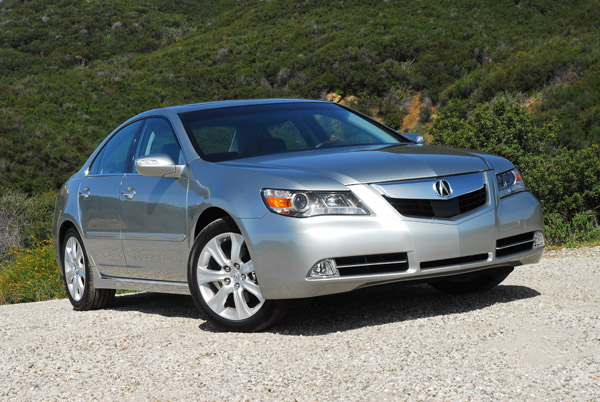
The 2010 RL’s exterior styling has been constantly updated making it distinctive and upscale front, side and back.  The RL’s athletic style gives an indication of the power concealed under the hood and features Acura’s signature front grille.  Love it or hate it, it works getting fresh air into the engine.  The front fascia also features unique lamp clusters with HID adaptive headlamps, daytime running lamps and just below another air intake to keep the engine cool when running.  Nicely formed foglamps have chrome bars through the opening.  Below the bumper is aerodynamic enhancements to help keep airflow smooth during high-speed travel.  The side shows raked A-pillars, a flat roof that quickly dives to the high-backed trunk lid with formed lip spoiler that helps keep the rear firmly pinned to the road at high speeds.  Pull-out door handles make it easy opening the wide-opening doors and just below is a tasteful chrome strip that runs the length of both doors, followed down below with lower side extensions giving the RL a lower center of gravity further enhancing stability.  The rear highlights include wraparound lamp clusters, a brushed aluminum horizontal bar running the length trunk, RL and SH-AWD badges, and two wide-octangular styled, polished stainless steel exhaust tips.  Under the rear bumper is another flat aerodynamic enhancement to help better manage airflow out the rear when traveling at high speeds.
Inside, the RL features an elegantly styled interior that includes leather-trimmed heated/cooled/10-way power adjustable sport bucket seats with excellent side bolstering to keep you in place during hard cornering.  The rear seats are also comfortable and feature a pull-down center armrest with pop-out dual cupholders and air-vents facing the rear at the end of the front center console.  The dual-cockpit style suits me just fine and really makes the RL’s interior unique especially with the CMBS adding real maple wood to the dash, center console and all four doors.
You’ll appreciate the easy to see instrument cluster with large centered 160mph speedometer, and smaller tachometer gauge to the left and to the right is another round gauge for fuel on board and engine coolant temperature.

The sporty leather-wrapped-wood steering wheel feels perfect in your hands and features power tilt/telescopic control.  There are buttons on the wheel for the audio system, communication systems and ACC.  The center stack contains all of the controls to use the climate control system, Bose Surround Sound 10-speaker system, Navigation system and the trip computer with easy to use buttons and dials.  All other buttons, switches and dials are within easy reach and fully illuminated for safe nighttime driving.  The front door storage pockets flip open for easy loading and unloading of small objects that you need. The rear seating area also comes with a pass-through for skis or other long items that do not fit in the trunk.
The RL interior also features an assortment of leading-edge technologies to enhance driver control and information access.  These technologies include Acura HandsFreeLink and Bluetooth-based wireless telephone interface that allows call to be made utilizing the RL’s steering wheel-mounted HandsFreeLink controls.  Standard on all RL’s is a spectacular Acura/Bose 10-speaker surround sound system with DVD-Audio, Bluetooth Audio, XM Radio and USB port/AUX jack connectivity.  A key component of the RL Technology Package is the Acura Navigation System with Voice Recognition.  The advanced system allows for easy control of key systems via voice control (with more than 700 commands) including voice guidance for turn-by-turn directions, over 7-million points of interest, Zagat Survey restaurant guide information, along with voice recognition to operate key audio and climate control functions.  The innovative AcuraLink satellite communication system features driver relevant technologies such as AcuraLink Real-Time Traffic with Traffic Rerouting and AcuraLink Real-Time Weather with continuously updated radar maps.

Occupant safety in the event of a collision is enhanced with the ACE body structure’s front-mounted polygonal frame design that increases occupant protection and crash compatibility in frontal crashes by utilizing a network of connected structural elements to distribute crash energy more evenly throughout the front of the vehicle-and away from the passenger compartment.  To enhance safety the RL employs active head restraints built into the front seats to help improve neck and head protection in the event of a rear impact.  To further air in safety, the RL includes standard six airbags, including side curtain airbags, and a Tire Pressure Monitoring System.  Other standard safety features includes 3-point safety belts with front load limiters/pretensioners, steel beams in each door, and the LATCH system for child seats.
Each RL comes standard with dual map lamps, dual lighted vanity mirrors; grab handles above each door, MP3 auxiliary jack, 12-volt/110-volt power plug, Acura aluminum door sill plates at each door bottom, two driver memory, remote opening trunk and fuel filler door, Homelink system, power moonroof, power remote sideview mirrors, self-dimming rearview mirror, power rear sunshade/manual rear side window shades, rain-sensing wipers/wipers, thick cut-pile carpeting and floor mats.
The new 2010 Acura RL has it all-plenty of high-performance, plenty of luxury, plenty of comfort front and back, plenty of convenience, plenty of high-tech creature comforts and enough safety systems to earn a 5-Star rating from the National Highway Traffic Safety Administration.
The loaded 2010 RL CMBS that I tested stickered for just $54,250.00, not bad for the total package.
COPYRIGHT:2010:HARVEY SCHWARTZ
SPECIFICATIONS
Price: MSRP $46,830 As-Tested $54,250
Type: Midsize Sedan
Where Built: Japan
EPA Class: Midsize Cars
Dimensions
Exterior
Length: 195.7 in.
Width: 72.7 in.
Height: 57.2 in.
Wheel Base: 110.2 in.
Ground Clearance: 5.7 in.
Curb Weight: 4110 lbs.
Interior
Front Head Room: 38.4 in.
Front Hip Room: 55.1 in.
Front Shoulder Room: 58.5 in.
Rear Head Room: 37.2 in.
Rear Shoulder Room: 56.1 in.
Rear Hip Room: 54 in.
Front Leg Room: 42.3 in.
Rear Leg Room: 36.3 in.
Luggage Capacity: 13.1 cu. ft.
Maximum Cargo Capacity: 13 cu. ft.
Maximum Seating: 5
Performance Data
Base Number of Cylinders: 6
Base Engine Size: 3.7 liters
Base Engine Type: V6
Horsepower: 300 hp
Max Horsepower: 6300 rpm
Torque: 271 ft-lbs.
Max Torque: 5000 rpm
Drive Type: AWD
Turning Circle: 36.1 ft.
0-60mph: 6.5 seconds
Fuel Data
Fuel Tank Capacity: 19.4 gal.
EPA Mileage Estimates: (City/Highway/Combined)
Automatic: 16 mpg / 22 mpg / 18 mpg
Range in Miles:
Automatic: 310.4 mi. / 426.8 mi. / 349.2 mi.

Concept Cars That Could Save The World


We’re all familiar with the nursery rhyme called “This Little Piggy” right? Does this sound familiar: “This little piggy went to market, this little piggy stayed home, this little piggy had roast beef, this little piggy had none, this little piggy cried ‘wee wee wee’ all the way home…”  Ok, by now if you’re still reading this you are thinking to yourself “what the heck does all this have to do with cars?” either that or you’re thinking “this guy has gone completely mad!” Well you might be right on both counts as I will soon explain.

The “piggys” going to market in this context are the concept cars that so many manufacturers dangle like a carrot in front of the viewing audience to excite our collective car senses, arouse our vivid mechanical dreams and whet our automotive appetites.  These prototypes are often the only indication consumers have that there’s somebody with imagination at the wheel of these major, mega,  car conglomerates.  The mostly pedestrian selection of mundane motor vehicles seen on the street today are largely a reflection of the apathy (i.e. mediocrity) found in our society at large.  While mostly functional, modern automobile design consists of general, uninspired, average and redundant variations on the same theme, the difference in branding offering the only variety.   Each manufacturer presents something for everybody to collectively like or dislike…agree or disagree, everyone’s entitled to their own opinion, Pontiac Aztec owners included.  But one thing that most can collectively agree upon is the detectability of the often futuristic concept cars. These visions that seem to be lifted from the pages of a science-fiction novel often end up gracing the pages of our favorite automobile magazine or automotive blog.
Best case scenario we get to see a working prototype,  but most commonly after we get our collective hopes up in anticipation of a newer model or our favorite concept car, the reality sets in that our favorite pending pet project will never see the light of day.  Concepts like a dream get deferred when these projects are abandoned before production starts, often due to lack of funding or due to designs that are so radical and so fantastic that there is no conceivable way to translate the effluent lines and renderings on paper into a tangible solid reality.  Those seldom seen prototypes become extinct like the 1948 Tucker Sedan, the DeLorean, and the  Dodo bird. Often we can blame the analytical corporate suits and bean-counters for their lack of vision (and their proficiency with a slide rule and cost analysis software) for nixing many a project coming down the pipeline.  Market volatility and consumer indifference round out the rest of the usual suspects way-laying development and contributing to why our automotive wet-dreams never become a reality.  Like that cute girl in high school that you always wanted to date but never worked up the nerve to ask out, it’s too late, game over, class dismissed, but back to the matter at hand.
Many of the prototypes and concept cars with the potential to proactively alter the way we think and relate to not only our cars, but also the automotive industry as a whole, stall out in some pre-production phase as auto makers impulsively shift focus in reaction to increasing government legislation, fickle consumer indifference, to copy the latest trend, or to jump on the popular band-wagon,  as opposed to setting the bar higher and bucking the trend becoming true visionaries and trail blazers with a clearly defined vision of what the future could be, but again, I digress. So without further ado, here is our list of proto-typical, future-conceptual cars that we feel are desperately needed today! These car might just save the world…or at least our sanity and along with it a few barrels of crude oil.
1. Mazda Furai concept car designed and manufactured by Mazda


Status: TBD
Dubbed the “sound of the wind” by designers, the Mazda Furai with it’s dramatic lines and complex curves sets the tone for what future-present cars should be.  Embodying the idea of flow, or “Nagare” design as Mazda calls it, the Furai concept car holds fast to Mazda’s history of incorporating the spirit of  “Zoom-Zoom” and the “Emotion of Motion” in their best selling cars, such as its popular predecessors the RX-7 and RX-8.  These cars that look fast just standing still! The Mazda Furai concept (pronounced ‘foo-rye’ in Japanese) celebrates the culmination of over 40 years of Mazda’s research and development in motorsports.

Why we need this car today:
Mazda partnered with BP oil and the Furai was designed with ethanol power in mind.  The Furai’s three-rotor 450hp mid-mounted wankel engine uses BP E100 ethanol as it’s fuel of choice.  With the increasing popularity and availability of  “green-energy” solutions and the usage of alternative fuels on the rise, such as E10 and E85 ethanol/gasoline blends, the Mazda Furai concept would be a welcome addition to the flex-fuel and green-fuel segment of the market, adding some much needed excitement to the rather hum-drum assortment of hybrid vehicles currently offered. Besides, we miss the 3rd gen, FD3S Rx-7’s sexy lines and curves and the Furai would pick up the slack where the RX-8 fell short.
2. Toyota FT-HS (HSC) Concept (a.k.a. the new “Supra”) designed by Calty Design Research and manufactured by Toyota


Status:TBD
“A long time ago, in a galaxy far far away” there existed a sports car of mythical proportions and it was called the MKIV 2JZ Toyota Supra.  Ok, so it wasn’t that long ago (for some of us it just feels that way) or even that far away for that matter…it was in Japan, circa 1997 that the last samurai,  I mean last Toyota Supra rolled off the assembly line…and in the wake of its passing the world let out a collective sigh of sadness.  For more than a decade,  die-hard Toyota Supra loyals have waited…impatiently, but waited just the same, for Toyota to revive one of the most popular sport compact cars of all time.  In 2007 the Supra faithful received a faint glimmer of hope that their waiting has not been in vain in the form of the Toyota FT-HS.
Officially named the “Future Toyota-Hybrid Sports” Concept or FT-HS for short,  the designers at Toyota proposed a rear-wheel-drive hybrid sports car that would output around 400 horsepower.  Touted as a  “new kind of sports car for the 21st century” Toyota hopes to combine “economy and emotion” in a complete sports car package with a performance aspiration of zero-to-sixty in four seconds and at a price in the “mid-$30,000 range.”  Lofty aspirations indeed for a company that has been sorely lacking a halo sports car offering since 1997,  when the last Supra model was dropped from the dealership line up, a decision that Toyota must undoubtedly regret in light of it’s recent financial worries in the wake of the massive accelerator pedal recall aka “Pedal-gate”.  In a year marked by slow sales and waning consumer confidence, a new Supra-type car could be the light at the end of the dismal recall tunnel for Toyota, bolstering sales and helping to offset some of the negative stigma and stem the tide of customer attrition that Toyota has garnered of late…at the very least it could serve as a very pleasant distraction: “hey look over there, is that the new Supra?”

Why we need this car today:
Two words: Toyota Recall.  For a new Supra-caliber car we would be willing to overlook Toyota’s recent gas-pedal gaff and let by-gones be by-gones…besides, who would ever complain about a sticking accelerator in a world class sports car? Most true spo-com enthusiasts probably wouldn’t even notice: “why no officer, I did NOT know I was doing 100 mph, must be this darn Toyota accelerator…”  Seriously though, the Toyota FT-HS Hybrid Sports Concept is rumored to be powered by a hybrid powertrain, possibly even a hybrid-electric motor (think: the love-child of mating a Toyota Prius with a big-block V8).  Hey, it could work…stranger things have happened.
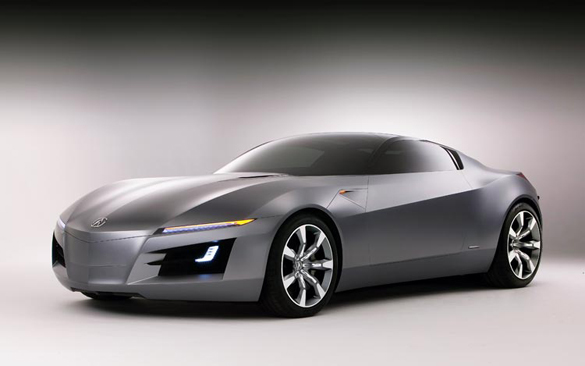
3. Acura Advanced Sports Car Concept/Honda FC Sport Concept (read: the new NSX) designed by the Acura Design Center and manufactured by Honda Motor Company


Status:TBD
Introduced in the early ’90’s, the NSX (New Sportscar ‘Xperimental’) prototype was Honda’s first foray into the exotic supercar market. The NSX was Honda’s technological and performance showcase and the Pininfarina designed NSX quickly became a fixture among the sport compact elite as an “affordable” alternative to the traditional staple of established exotic super cars by brands such as Lamborghini and Ferrari.  Rumor has it that the NSX even inspired F1 designer Gordon Murray’s McLaren F1 Supercar concept.  In 2005 production of the NSX was discontinued with Honda citing economic issues and their desire to re-design the then dated and aging platform. Loosely based on Honda’s formula one efforts, an F1-derived V-10 was originally purported to be tapped for duty in the new NSX, but amid economic woes and recent changes in the marketplace,  one of Acura’s existing 3.4-liter, V-8 powerplants or even possibly a hybrid/electric motor are considered more likely candidates. Additionally, Honda has recently released information on their FC Sport Concept car which threatens to be a “true no-holds-barred supercar” powered by a “high-torque electric motor” designed to rival even the greatest of modern sports exotics!  The “FC”in FC Sport is short for “Fuel Cell”,  utilizing the same technology as the FCX-Clarity Fuel Cell Electric Vehicle which is an alternative fuel, zero emissions car. Factor in Acura’s Super Handling All-Wheel Drive (SH-AWD) technology and what do you have: The makings of an ultimate alternative energy exotic super sports car wonder wagon! Now try saying that three times fast!

Why we need this car today:
Honda/Acura desperately needs to develop a new sports car to continue the legacy of it’s award-winning NSX supercar.  Who better than Honda,  whose slogan is “The Power of Dreams” to translate their vision for a new,  NSX-type concept car into a reality?  If Honda Motor Co. was a kid in your high-school year book, the caption under the picture would read “Most Likely to Succeed” and true-to-form this Japanese powerhouse of manufacturing has been going strong for a long time.  With the recent demise of the Honda S2000, it’s high time for another Honda Halo-car to step up to the plate…can you say “Home Run”?
4. Dodge Zeo Concept  designed by Chrysler Group LL (Chrysler Dodge Jeep)


Status: TBD
The Dodge Zeo, short for  “Zero Emissions Operations” Concept  vehicle is likely to be the Chrysler Group’s newest crowning achievement with it’s entry into the increasingly popular hybrid vehicle market. Labeled by the manufacturer as a “next generation muscle car”  the Zeo electric sports car follows in the footsteps of the now well-established all-electric exotic Tesla Roadster. Designed as  “four-passenger sport wagon”  (think Subaru Forrester, WRX hatchback, etc.) the Dodge Zeo is a happy concession, seeking the middle ground between environmentalists and enthusiasts alike. Reportedly the Zeo’s electric, lithium-ion battery powerplant can last up to 250 miles before needing recharging and goes from 0-60 miles per hour in under six seconds.

Why we need this car today:
The fact that this car has an all-electric motor is definitely a step in the right direction for both Chrysler and those wanting to end our dependence on fossil fuels; besides it would be fun to hear people ask “Does That Thing Have A Hemi?”
5. BMW GINA light visionary model concept/BMW Vision EfficientDynamics Concept designed by BMW Group Design


Status: TBD
The BMW GINA which stands for “Geometry and Functions In ‘N’ Adaptions” is an experiment in abstract thinking that at first glance is so outside the box it seems to defy logic. The GINA concept with it’s variable geometry technology can change the shape of the vehicle surface through a series of manipulations achieved via the textile fabric skin and metal/carbon fiber supporting sub-structure.  Couple the GINA concept with the BMW Vision concept car and it becomes readily apparent that someone over at BMW is thinking in the right direction. Intended as a 2+2-seater with full-hybrid technology, the BMW Vision concept vehicle would combine the performance of a BMW M series, with a low emission, fuel efficient engine and would probably outperform even the most economical internal combustion engines around today. BMW’s combination of ActiveHybrid components and outstanding aerodynamic qualities ensure that enjoyment and overall driving experience increases, even as fuel consumption and emissions decrease. While no slouch in the power department, the engine provides a maximum speed governed to just 155 mph, reaching 0 to100 km/h in 4.8 seconds. Average fuel consumption is a reported 62.6 mpg, and the CO2 emission rating is 99 grams per kilometer or better when driving in “all-electric mode”.

Why we need this car today:
A BMW M-series vehicle with the potential for 62 mpg!!!  Enough said, where do we sign up?

The New Honda “NSX” destined for GT500 Fame


In this corner, weighing in at a curb weight of approximately 2,425lbs. (1,100 kg), the new champion of the GT500 class, the Honda HSV-010 GT, or at least that’s what Honda hopes to hear one day soon.  Earlier this year, Honda Motor Co. introduced it’s latest contender for JGTC fame, the Honda Sports Velocity 010 GT Super car.  The liquid-cooled, naturally aspirated, F/R, longitudinal V8 HR10EG powered car is the unlikely avatar created by Honda in their contention for GT fame in the 2010 Autobacs Super GT Championship Series of Japan.
Honda Civic

Having successfully campaigned with the Honda NSX during the mid ’90s,  the HSV-010 will replace the now defunct NSX Super GT car.  A reworked purpose-built 3.4L engine analogous to the 500 PS DOHC previously used by Honda in the NSX is at the heart of this track terror and will hopefully propel it to victory in all of it’s gear-driven, paddle shifting glory. The HR10EG is borrowed from the 3.4-liter V8 engine used by Honda in Formula Nippon and has been transplanted into the HSV-010 for Super GT. Originally the HSV-010 was to be based on the now canceled Acura Advanced Sports Car Concept a.k.a the “New NSX” production vehicle. But market instability and  ongoing economic concerns have prohibited Honda’s efforts to proceed full-steam ahead with a production vehicle that is available to the general public for consumption, instead opting to just dip a proverbial “toe-in-the-water” with the  HSV-010 GT, keeping the spirit of it’s predecessor the NSX-GT alive and serving as a test bed for research & development while simultaneous pulling double-duty as Honda’s unattainable new Halo car.
Honda engineers designed the HSV-010 GT to be “the ultimate cornering machine” surpassing  even the NSX in a front-engine rear-drive layout, a configuration that is a new experiment to the manufacturer in their Super GT machine.  With their new advances combined with proven technology from the NSX, the HSV is intended to be an “easy-to-handle, but high performance super car.  All this sounds well and good and we wish Honda much success with their JGTC campaign and racing aspirations, but this news does little to fill the void left behind with the demise of both the NSX and the S2000.  The fact that the  HSV-010 GT exists at all only adds insult to injury, rubbing salt in our concept car craving wounds…maybe ASL will step up to the plate and put the Garaiya into production…hmmm Garaiya.